Best Garage Door Insulation Kits (2026): R-Value Per Dollar Compared
Garage door insulation kits range from about $60 to $185 per single door, and the R-value you get for each dollar varies even more. Here is the math, shown line by line, plus the two things most kit reviews skip: door balance and air leaks.
The Brofessionals is reader-supported. When you buy through links on this page we may earn a small commission at no extra cost to you. As an Amazon Associate we earn from qualifying purchases. See our full disclosure.
An uninsulated steel garage door is basically a thin sheet of metal between your garage and the weather. Adding a kit won’t turn the garage into a conditioned room, but it can take the edge off winter cold and summer heat radiating off the door, and some kits cut road noise.
This guide is research-based. We haven’t run these kits side by side; the numbers below are manufacturer specs and retailer listings checked in September 2026, and we say where a claim couldn’t be verified.
Quick comparison
| Kit | Material | Stated R-value | Coverage per kit | Price seen (Sept 2026) |
|---|---|---|---|---|
| Cellofoam 8-piece | 1¼-in EPS foam, laminated white facer | About R-4.6 at 75°F, R-5.0 at 40°F | 8 sheets, 20 x 54 in; about 60 sq ft, a door up to 9 ft wide | About $60 at Home Depot |
| NASA Tech 2-car (US Energy Products) | Foam core between reflective foil layers, white face | R-8 (reflective rating; see caveat) | One kit for a 16 x 8 ft (also 16 x 7) door; 18-ft version sold separately | About $60 (1-car, 9 x 8) and $109 (16 x 8) at WoodArtSupply; about $125 (18 x 8) listed by a Walmart marketplace seller (out of stock when checked) |
| Owens Corning GD01 | Fiberglass with white vinyl facing | R-8 (tested per ASTM C177) | 8 panels, 22 x 54 in; single door up to 9 ft wide | About $184 at Home Depot |
| Matador (Atlas EPS) | EPS foam, high-impact polystyrene laminate | R-4.8 | 8 panels, 21 x 54 in; 49 sq ft | About $145 at Ace; about $181 at Home Depot |
| Reach Barrier 3009 | Reflective (“Reflective Air²”) | Not listed by the maker | 8 pre-cut panels, about 24 x 48 in | About $59 at Home Depot; $69.99 at reachbarrier.com |
Prices are what we saw on the linked pages in September 2026 and move often. We could not load Amazon or Lowe’s listings for these kits, so check those yourself.
R-value per dollar, worked out
The metric is simple: stated R-value ÷ price to cover one door × 100, which gives “R-points per $100.” Higher is better value. Assumptions:
- Single door means an 8 or 9 ft wide, 7 ft tall door, one kit.
- Double door means 16 ft wide. Single-door kits (Owens Corning, Cellofoam, Matador) are counted as two kits. NASA Tech sells a one-piece 16-ft kit.
- Prices are the lowest we saw on a page we could load. Tax and shipping aren’t included.
- Stated R-values are taken at face value, which flatters reflective products (more on that below).
| Kit | Stated R | Single door: cost / R per $100 | 16-ft door: cost / R per $100 |
|---|---|---|---|
| Cellofoam | 4.6 | $59.98 / 7.7 | $119.96 (2 kits) / 3.8 |
| NASA Tech | 8 (reflective) | $59.88 (1-car kit) / 13.4 | $108.88 (1 kit) / 7.3 |
| Owens Corning GD01 | 8 | $184.30 / 4.3 | $368.60 (2 kits) / 2.2 |
| Matador | 4.8 | $144.99 / 3.3 | $289.98 (2 kits) / 1.7 |
| Reach Barrier 3009 | Not listed | $58.88 / — | $117.76 (2 kits) / — |
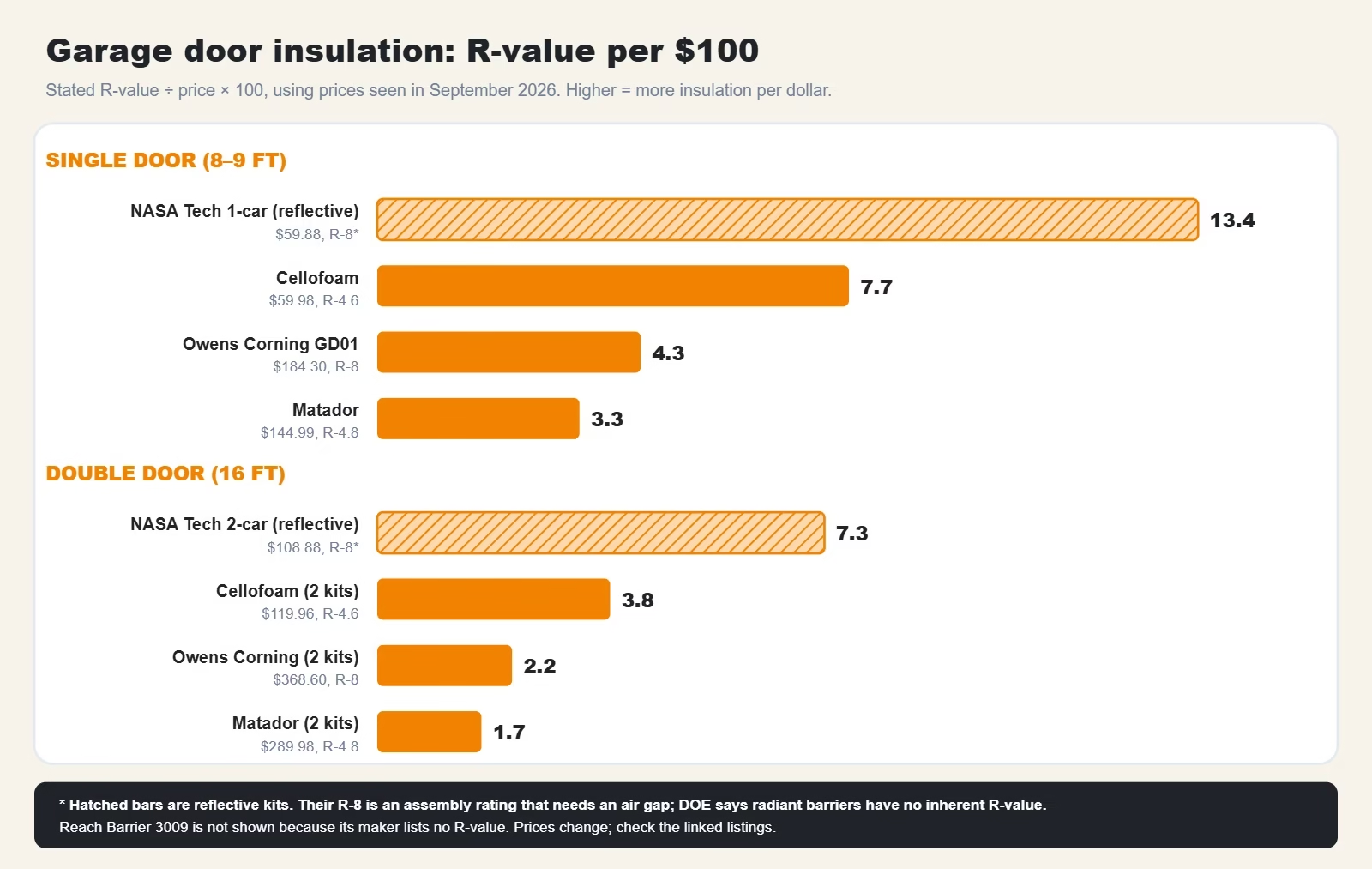
Worked example for a single door: Owens Corning is R-8 for $184.30, so 8 ÷ 184.30 × 100 = 4.3 R-points per $100. Cellofoam is R-4.6 for $59.98, so 7.7. Cellofoam gives you less insulation, but each dollar buys nearly twice as much of it.
The big caveat on reflective kits. The Department of Energy says a radiant barrier “has no inherent R-value” and that the reflective surface must face an air space to work. Reflective kits like NASA Tech and Reach Barrier get their ratings as an assembly with that air gap, while foam board and fiberglass carry their R-value in the material itself. So NASA Tech’s 13.4 (single door) and 7.3 (double door) are the best numbers on paper, but it isn’t an apples-to-apples comparison with Owens Corning’s R-8 fiberglass. If you want a number you can lean on, Cellofoam is the value pick among the foam and fiberglass kits.
How much difference does door insulation actually make?
Be realistic here. Building-science guidance from the DOE’s Building America Solution Center treats an attached garage as unconditioned space. The wall and ceiling between the garage and your house are the real thermal boundary, and the same guide calls air control between garage and house “the most important function” of that wall, because of carbon monoxide and fumes as much as energy.
What that means in practice:
- A door kit mainly changes the garage’s temperature. It helps most if you work out there, heat it, have a bedroom over it, or share a leaky wall with the house.
- If your goal is a lower heating bill, sealing and insulating the house-to-garage wall, the attic hatch and the door into the house usually matters more than the big door.
- Manufacturer savings claims (for example “20% or more” on NASA Tech listings, or Owens Corning’s “5 times better thermal performance” versus an uninsulated door) are marketing numbers from the brands. We couldn’t find independent tests that confirm a specific bill reduction, so treat them as best-case.
Which kit for your door type
| Your door | Best fit | Why |
|---|---|---|
| Uninsulated steel pan door (hollow back, visible ribs and stiles) | Cellofoam or Matador friction-fit foam; Owens Corning if noise matters | These kits are sized for the pans between steel stiles; Matador describes its panels as fitting the metal framing on metal doors. |
| Steel door, budget priority, double width | NASA Tech 2-car or two Cellofoam kits | Lowest cost to cover 16 ft; foam gives a more trustworthy R-value. |
| Flush steel door (no recessed pans) | Reflective roll (NASA Tech) taped on | Friction-fit panels need a frame to wedge into. |
| Wood door (raised panel or carriage style) | Check with the door maker first | These kits are marketed for metal doors; wood doors are often heavier to begin with and may not have pockets for panels. We couldn’t find a door maker that approves these kits for wood doors, and added weight changes the spring balance, so ask your door’s manufacturer or a garage door technician first. |
| Already insulated door (foam-filled or steel-backed) | Skip the kit | Spend the money on a new bottom seal, side and top weatherstripping, and the house-to-garage wall. |
The kits, briefly
Cellofoam Garage Door Insulation Kit: best value per dollar
Eight 1¼-inch EPS foam sheets (20 x 54 in) with a white laminated face, covering about 60 sq ft, which Cellofoam says suits a typical 9-ft door. The rating is about R-4.6 at 75°F and R-5.0 at 40°F, so it performs a bit better in the cold. At about $60 at Home Depot, it is the cheapest verified way to put real foam on a single door.
NASA Tech Reflective Foam Core: cheapest way to cover a double door
US Energy Products sells this as a foam core laminated between reflective foil layers with a white face, cut from rolls and stuck on with double-sided tape. The 18 x 8 kit includes the tape, a razor blade and a squeegee. Listings claim R-8, which depends on the air gap caveat above. It is the lowest-cost option we found for a 16-ft door, about $109 for the 16 x 8 kit.
Pros
- One kit covers a 16 x 8 or 16 x 7 door
- Works on flush doors where friction-fit panels won’t
- Thin and light, so minimal added weight
Cons
- R-8 is an assembly rating that assumes an air gap
- Tape adhesion is the weak point in hot or humid garages
- Looks less finished than rigid panels
Owens Corning GD01: best for noise and a true R-8
Fiberglass panels with washable white vinyl facing, R-8 tested per ASTM C177, eight 22 x 54 in panels for a single door up to 9 ft wide. Home Depot’s listing claims a 20% noise reduction. Owens Corning’s spec sheet recommends installing between 69°F and 100°F, so do this before the cold arrives. At about $184 per single door, it is the most expensive per R-point after Matador.
Matador: most finished look
Rigid EPS panels with a high-impact polystyrene laminate that friction-fit into the door’s metal framing, rated R-4.8, 49 sq ft per kit. It looks the most like a factory-insulated door and carries a limited lifetime warranty per Home Depot’s listing. You pay for that finish: at about $145 (Ace) to $181 (Home Depot), it has the lowest R-value per dollar here.
Reach Barrier 3009: cheapest single-door reflective kit
Eight pre-cut reflective panels (about 24 x 48 in) with 48 double-sided foam “Stick’ems” pads, about $59 at Home Depot. Reach Barrier’s product page doesn’t list an R-value, so we can’t score it on R-value per dollar until we confirm one. Good for a quick, light upgrade on a single door.
Before you install: check the door’s balance
Every kit adds some weight, and your door’s springs are set for the weight it had. One garage door company notes reflective kits add little, while foam board can add 10 to 25 pounds or more to a double door. An out-of-balance door makes the opener strain and wears it out early.
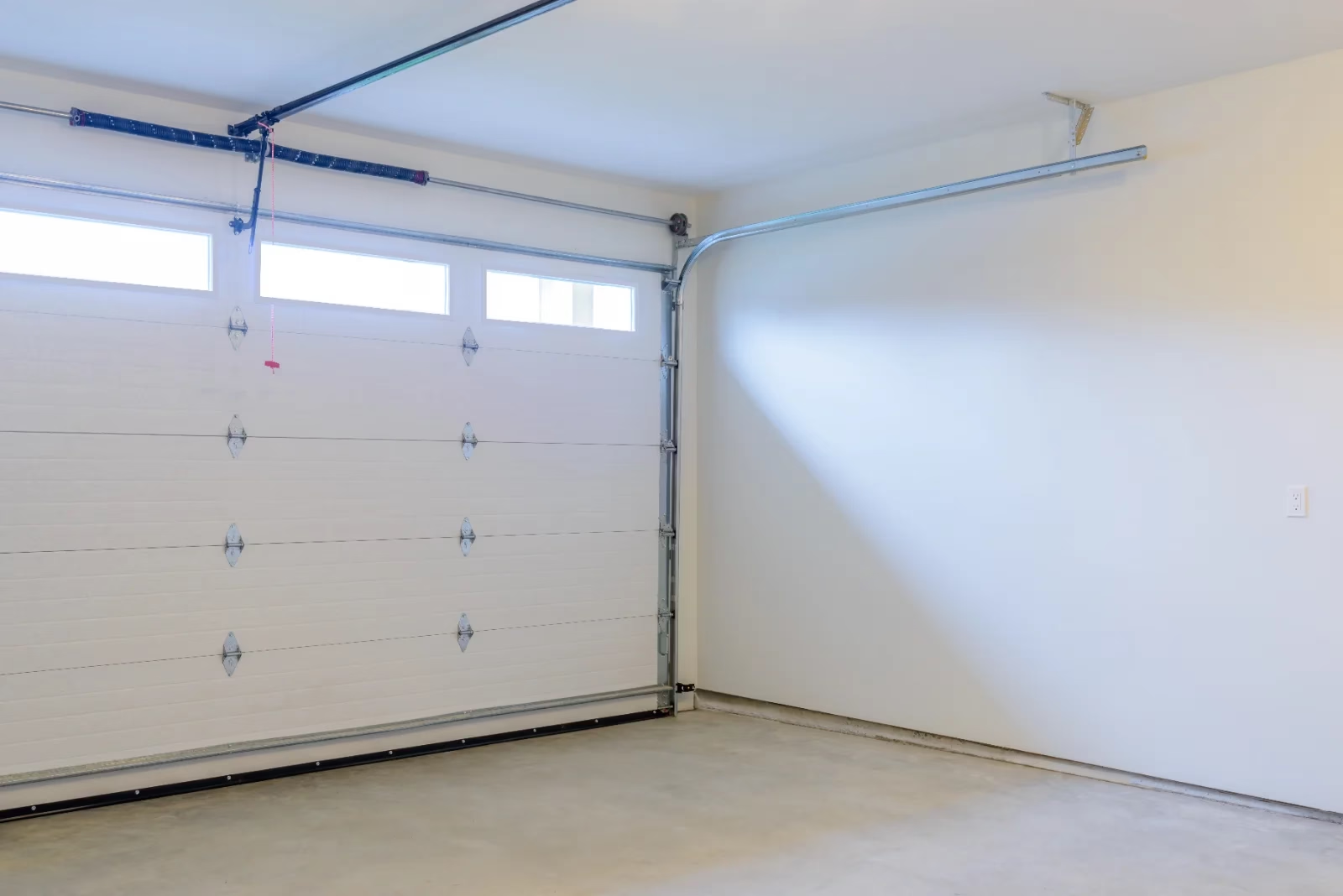
Chamberlain’s balance test, done before and after the install:
- Close the door and disconnect it from the opener with the manual release.
- Lift it by hand. It should move smoothly with one hand.
- Raise it 3 to 4 feet and let go. A balanced door stays put or drifts slowly.
- If it drops hard or shoots up, it needs a spring adjustment.
Pair it with weatherstripping
A kit insulates the panels, not the gaps. Daylight under the bottom edge, along the sides or across the top lets in more cold air than the panels let through. For the most noticeable change:
- Replace a cracked or flattened bottom seal. Measure the retainer channel profile first; seals are sold by type (bottom seals on Amazon).
- Add or replace side and top stop molding weatherstripping (stop molding weatherstrip on Amazon).
- Seal the door from the garage into the house and any gaps in the shared wall. That protects your indoor air from car exhaust, as well as saving energy.
Measuring panels carefully saves you from re-cutting foam. A tape is fine, but if you’re also hanging shelving, our roundup of laser levels and smart measuring tools for homeowners covers tools that make both jobs faster. Once the door is done, our guide to garage wall and overhead storage systems helps you use the space.
FAQ
Read next: Garage wall and overhead storage systems · Best cordless drills under $150 · Ryobi vs DeWalt impact driver · Laser levels and smart measuring tools · All DIY guides
Sources
- Home Depot: Owens Corning GD01: R-8, 8 panels at 22 x 54 in, fiberglass with vinyl facing, 20% noise claim, $184.30
- Owens Corning GD01 spec sheet: R-8 per ASTM C177, single doors up to 9 ft, 69–100°F install range
- Cellofoam: Garage Door Insulation Kit: R-4.6 at 75°F / R-5.0 at 40°F, 8 sheets 1¼ x 20 x 54 in, 60 sq ft, 9-ft door
- Home Depot: Cellofoam kit: $59.98
- Ace Hardware: Matador kit: R-4.8, 21 x 54 in, 49 sq ft, fits metal framing on metal doors, $144.99
- Home Depot: Matador GDIKSM: EPS, limited lifetime warranty, $180.66
- WoodArtSupply: NASA Tech 16 x 8 kit: R-8 claim, foil/foam core, 20% savings claim, $108.88
- WoodArtSupply: NASA Tech 1-car 9 x 8 kit: R-8 claim with an air pocket, 4 rolls of 2 x 18 ft foam core, $59.88 on sale
- Walmart: NASA Tech 18 x 8 kit: contents (tape, razor, squeegee), $124.88 marketplace listing (out of stock when checked)
- Reach Barrier: 3009 kit: 8 panels about 24 x 48 in, 48 foam pads, $69.99, no R-value listed
- Home Depot: Reach Barrier 3009: $58.88
- DOE Energy Saver: insulation: radiant barriers have no inherent R-value and need an air space
- Building America Solution Center: house-garage walls: garage as unconditioned space; air control is the key function
- Building America Solution Center: air sealing attached garages: carbon monoxide and contaminant isolation
- Chamberlain: how to test garage door balance: test steps; never adjust springs yourself
- Overhead Door Company of Huntsville: added weight of insulation and effect on springs and opener
Checked September 2026. Prices and specs change; confirm on the linked pages before you buy.