Third-Party Solar Panels That Work With EcoFlow (Voc Limits + Adapter Guide)
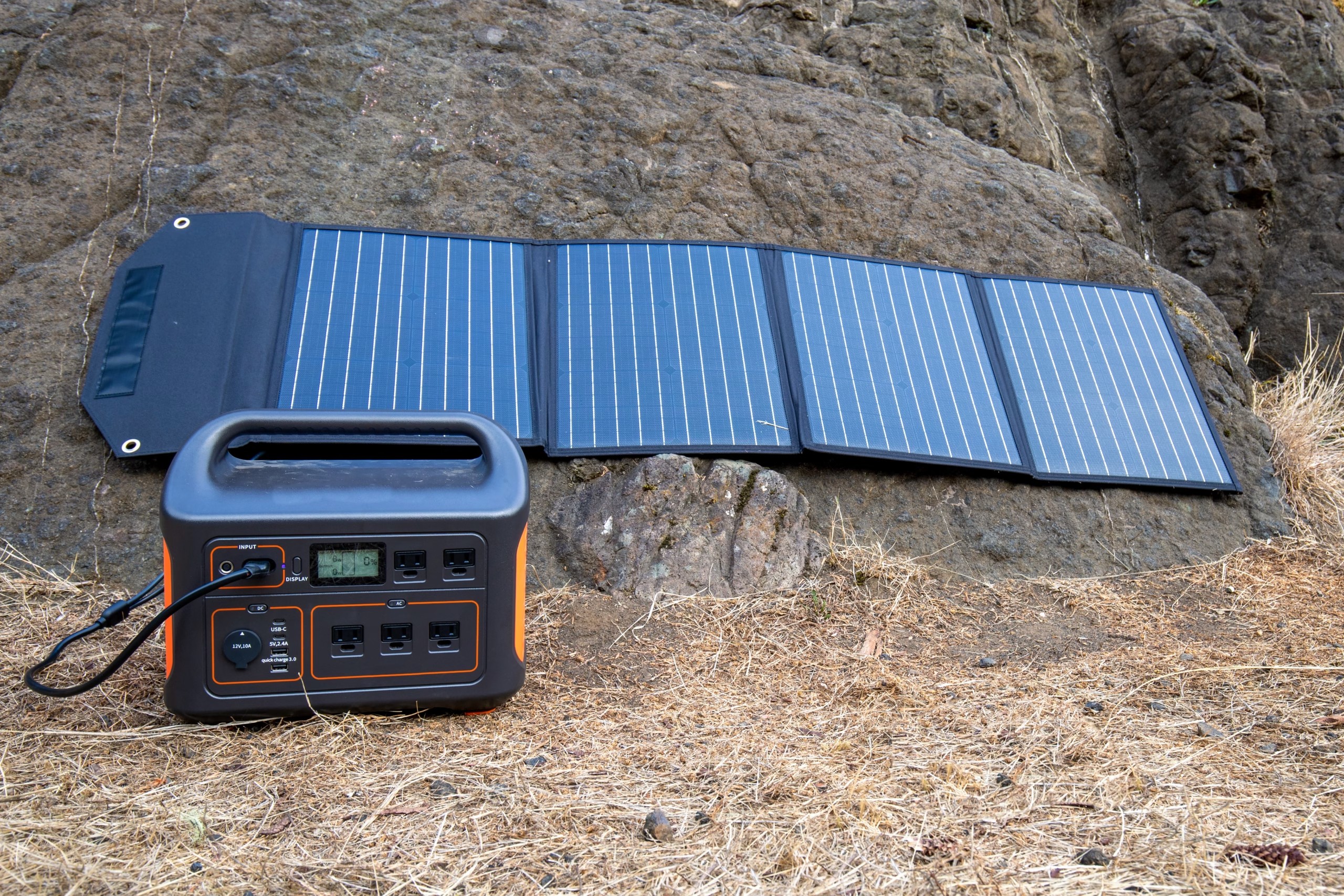
Third-party solar panels absolutely work with EcoFlow power stations — you just need the panel’s open-circuit voltage (Voc) inside your station’s accepted range and the right MC4-to-XT60i adapter. Here is the compatibility math and the exact gear to buy.
The Brofessionals is reader-supported. When you buy through links on this page we may earn a small commission at no extra cost to you. As an Amazon Associate we earn from qualifying purchases. See our full disclosure.
The Short Answer
Yes — you can charge an EcoFlow power station with a third-party solar panel, and plenty of owners do it to save money over EcoFlow’s own panels. Two things have to line up: the panel’s open-circuit voltage (Voc) has to sit inside your specific EcoFlow model’s accepted input voltage window, and you need the right cable to adapt the panel’s MC4 connectors to EcoFlow’s XT60 or XT60i solar input port. Get both right and a $100 generic panel will charge an EcoFlow station just as well as a $200 first-party one.
What Voc Actually Means (And Why It Is the Number That Matters)
Open-circuit voltage (Voc) is the voltage a solar panel puts out when it is connected to nothing — no load pulling current. It is always higher than the panel’s operating voltage under load, and it is the number printed on the panel’s spec sheet that a charge controller sees the instant you plug it in. Every EcoFlow power station has a maximum accepted input voltage, and if a panel’s Voc exceeds that ceiling, the unit’s overvoltage protection will refuse to charge, or in some cases can damage the input circuitry.
EcoFlow Solar Input Specs by Model
These are the widely reported input windows for popular EcoFlow models. EcoFlow updates specs across generations (River vs River 2 vs River 3, Delta vs Delta 2 vs Delta 3, and so on), so always cross-check your exact model and generation against EcoFlow’s official manual before wiring anything up.
| Model | Voltage Window | Max Solar Input |
|---|---|---|
| RIVER 2 / RIVER 2 Pro | 11–60V | Up to 220W (Pro) |
| DELTA 2 | 11–60V | Up to 500W (13A limit) |
| DELTA Pro | Up to ~150V (multi-panel strings) | Up to 1,600W (15A limit) |
The Connector Problem: XT60i vs MC4
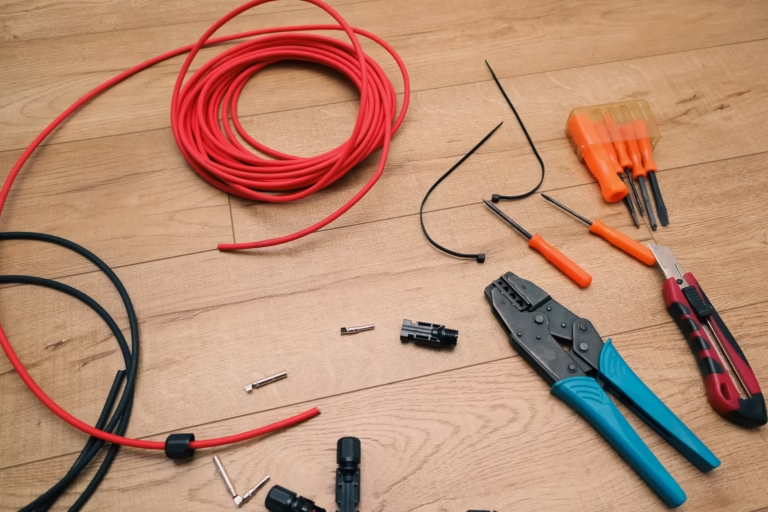
Almost every rigid or folding solar panel sold today, including the ones in our 200W portable panel roundup, ships with MC4 connectors — the weatherproof, IP67-rated standard used across the solar industry. EcoFlow power stations, on the other hand, use a compact XT60 or XT60i port for solar input rather than MC4. The XT60i variant EcoFlow uses on newer models adds a small third pin that some units use to help identify the charging source; using the correct XT60i-specific cable (rather than a generic XT60 cable) avoids charge-rate limiting on models that check for it.
The fix is a single inexpensive cable: an MC4-to-XT60i adapter. Plug the panel’s MC4 leads into one end and the XT60i end into your EcoFlow unit’s solar input, and you are charging. For a full breakdown of every connector type you might run into across different power station brands, see our MC4, XT60, and Anderson connector guide.
Check EcoFlow MC4-to-XT60i Charging Cable on Amazon →
Compatible Third-Party Panels
Renogy and ACOPOWER are two of the most commonly used third-party brands with EcoFlow stations, mainly because their single-panel Voc ratings sit comfortably inside the RIVER 2 and DELTA 2 voltage windows.
| Panel | Typical Voc | Ships With | Compatible EcoFlow Models (single panel) | Notes |
|---|---|---|---|---|
| Renogy 100W–200W rigid or portable | ~21–25V | MC4 | RIVER 2 / RIVER 2 Pro, DELTA 2 | Comfortably inside the 11–60V window; needs MC4-to-XT60i adapter |
| ACOPOWER 200W portable | ~23–24V | MC4 | RIVER 2 / RIVER 2 Pro, DELTA 2 | Same adapter requirement; verify current datasheet before buying |
Do
- Confirm the exact Voc on your panel’s datasheet, not a marketing summary
- Add a 10–15% cold-weather buffer below your station’s voltage ceiling
- Use an XT60i-specific cable on EcoFlow models that support it
Don't
- Wire multiple panels in series without recalculating combined Voc
- Assume a bare MC4 cable will physically fit an EcoFlow port — it will not without an adapter
- Ignore your specific model’s manual in favor of generic specs from a different generation
Check Renogy 200W Portable Solar Panel on Amazon → Check ACOPOWER 200W Portable Solar Panel on Amazon →
Common Mistakes That Trip Overvoltage Protection
The single most common mistake is stringing two or more panels in series without adding up their combined Voc. Two 24V-Voc panels wired in series produce roughly 48V combined — still fine for a RIVER 2’s 60V ceiling, but four in series would push past it. The second most common mistake is buying panels sized for a full rooftop array, which often carry Voc ratings in the 40–50V range per panel and can quickly exceed a portable station’s window once you add even one more panel in series. When in doubt, wire panels in parallel instead of series if your station’s amperage limit allows it, since parallel wiring keeps combined voltage the same as a single panel.
FAQ
Read next: Best 200W Portable Solar Panels of 2026 · MC4, XT60, Anderson: The Solar Connector Guide · How to Build a Solar Generator at Home. For more picks across the category, see our full solar buying guide.