Balcony Solar in the US (2026): What’s Legal, What Works, What to Buy

Plug-in “balcony solar” has been standard in Germany for years — it’s finally arriving in the US. Here’s what’s actually legal right now, what the hardware looks like, and how to get started without running afoul of your utility or HOA.
The Brofessionals is reader-supported. When you buy through links on this page we may earn a small commission at no extra cost to you. As an Amazon Associate we earn from qualifying purchases. See our full disclosure.
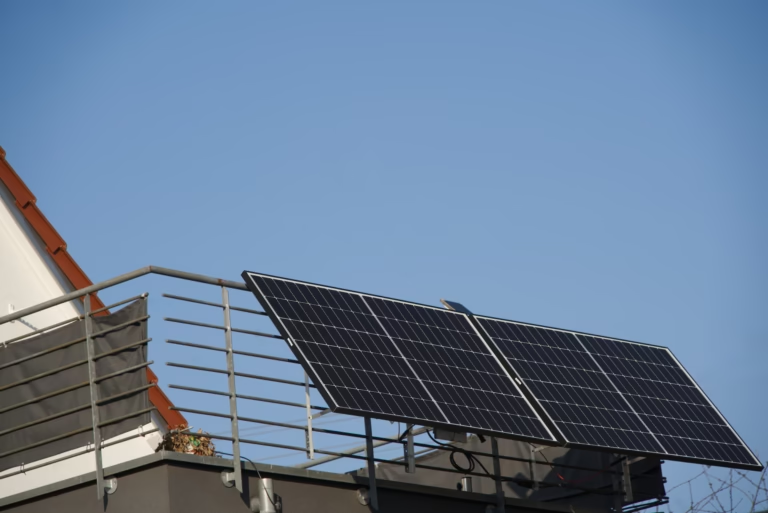
Balcony solar (also called plug-in solar or a mini solar kit) is exactly what it sounds like: one or two solar panels that mount to a railing or lean against a wall and plug directly into a standard wall outlet, feeding power back into your home’s circuit whenever the sun is out. It’s been common in Germany and other parts of the EU for years. In the US, it’s a genuinely new category — and the legal picture is still catching up state by state.
Where It’s Legal Right Now
As of July 2026, at least eight states have passed plug-in solar laws, though not all are in effect yet, and several more (including New York and New Jersey) have bills awaiting a governor’s signature. Exemption-state caps typically run 1,200W, with Colorado allowing up to 1,920W once its law takes effect.
| State | Status |
|---|---|
| Utah | In effect since May 2025 — up to 1,200W |
| Maine | Signed; phasing in starting mid-to-late July 2026 — up to 1,200W (over 420W needs a licensed electrician plus utility notice) |
| Virginia | In effect since July 1, 2026 — up to 1,200W, no permit or utility approval required |
| Maryland | In effect since May 2026 — up to 1,200W (pre-installation utility notification required) |
| Vermont | In effect since July 1, 2026 — up to 1,200W per electric meter |
| Connecticut | Signed; effective October 1, 2026 — up to 1,200W |
| New Hampshire | Signed July 2026 — up to 1,200W (effective date still rolling out — confirm current status) |
| Colorado | Signed; not effective until January 1, 2027 — up to 1,920W |
| Everywhere else | Legal gray area — not explicitly banned, but no formal exemption yet; New York and New Jersey have bills awaiting the governor’s signature |
What the Hardware Actually Looks Like
A typical balcony solar kit is one or two rigid or flexible panels (roughly 400–1,200W combined), a microinverter that converts the panel’s DC output to home-compatible AC, and a standard grounded plug. EcoFlow’s STREAM system, which launched in the US in July 2025, was one of the first mainstream kits built specifically for this use case, and other brands have followed with similar plug-and-play kits.
Pros
- No permit or formal utility interconnection required in exemption states
- Installs in under an hour — no electrician needed for a basic setup
- Renter-friendly: mounts to a railing and unplugs when you move
- Pairs naturally with a portable power station for battery storage
Cons
- Output is small relative to full rooftop solar — this offsets some of your bill, not all of it
- Legal status outside the states with active exemptions is still developing, and effective dates vary even among states that have passed a law
- Some utilities cap how much a plug-in system can feed back regardless of state law
- HOA and lease restrictions are a separate hurdle from the legal question
Check Balcony Solar Panel Kit on Amazon → Check Ecoflow STREAM Solar on Amazon →
Getting Started: A Simple Checklist
- Check your state’s status against the table above, then confirm with your specific utility — exemption laws set the ceiling, but utilities can still have their own interconnection rules.
- Check your lease or HOA rules if you rent or live in a managed community.
- Choose a kit sized to your outlet’s circuit capacity — most plug-in kits are sized to your specific state’s wattage cap and your circuit’s rating — a standard 15A household circuit tops out around 1,800W, well above any current state limit.
- Mount panels somewhere they’ll actually get consistent sun — south-facing balconies perform dramatically better than shaded or north-facing ones.
- Plug in and monitor production through the manufacturer’s app for the first few weeks to confirm everything’s working as expected.
FAQ
Read next: Can You Put Solar Panels on Your Balcony? (FAQ) · How to Build a Solar Generator at Home