Quietest Generators for RV AC (dB Guide)
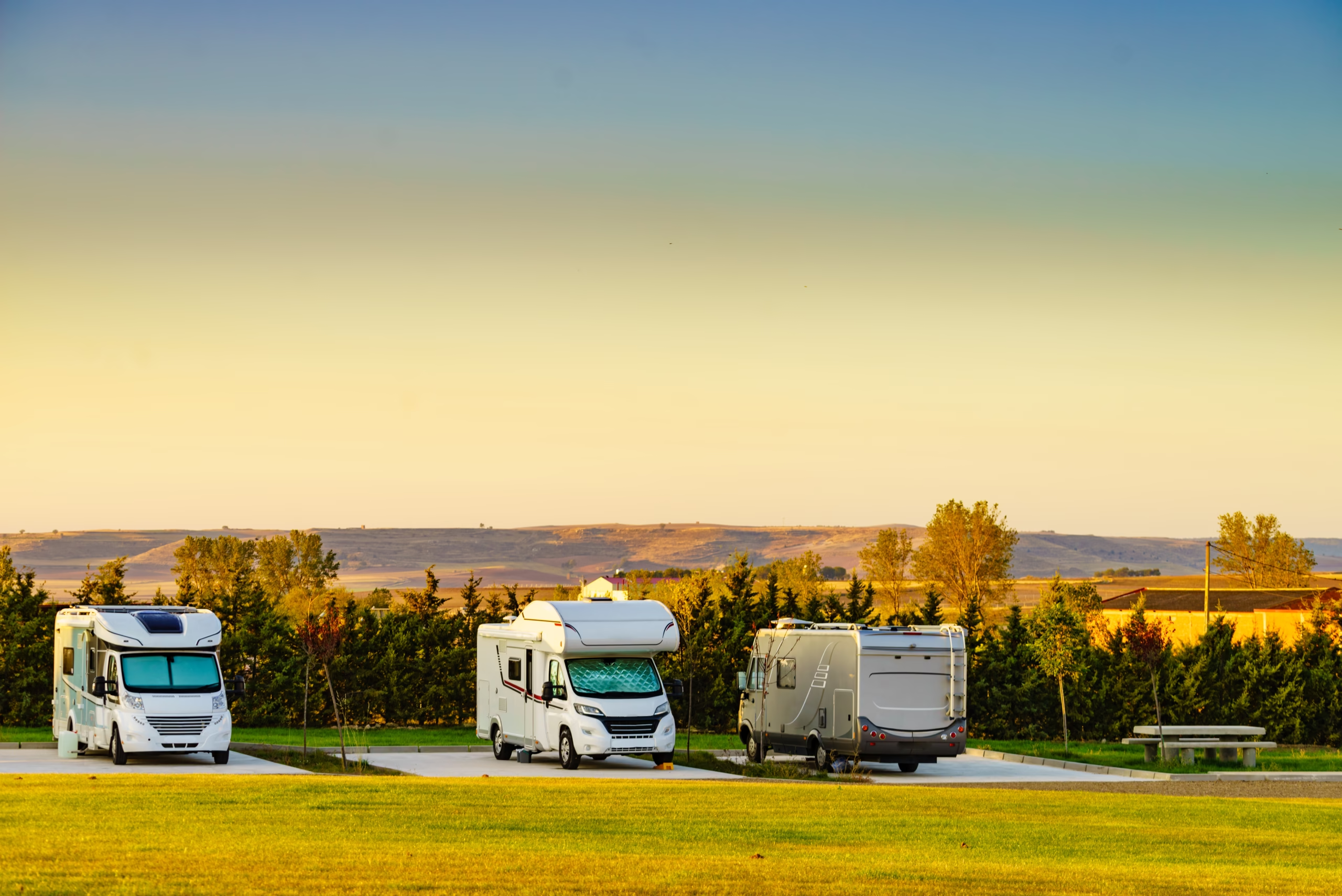
Most campgrounds have quiet hours and generator noise limits — usually 60dB or less at 50 feet. Here’s what that means in practice, and what it takes to actually run RV air conditioning without violating it.
The Brofessionals is reader-supported. When you buy through links on this page we may earn a small commission at no extra cost to you. As an Amazon Associate we earn from qualifying purchases. See our full disclosure.
RV air conditioners are power-hungry: a typical 13,500 BTU rooftop AC unit needs roughly 2,500–3,500W of surge power to start and 1,200–1,500W running, which rules out the smallest inverter generators. The challenge is finding a generator with enough output to handle that load while staying under most campgrounds’ posted noise limits.
| Reference Point | Value |
|---|---|
| Typical campground quiet-hour noise limit | 60dB or less, measured at 50 feet |
| 13,500 BTU RV AC surge draw | ~2,500–3,500W |
| 13,500 BTU RV AC running draw | ~1,200–1,500W |
| Recommended generator class | 3,000–3,500W inverter generator |
What Actually Determines Noise Level
Pros
- Inverter technology throttles engine speed to load, cutting noise significantly at partial load (which is most of the time an AC unit isn't in its startup surge)
- A larger fuel tank and eco-mode setting extends quiet, steady-state runtime without needing to run at full throttle
- Placement matters as much as the spec sheet: distance, elevation, and barriers between the generator and neighboring campsites all reduce perceived noise
- Dual-fuel and propane models tend to run marginally quieter than gasoline at comparable output
Cons
- Manufacturer dB ratings are measured at 23–25% load in ideal conditions — actual noise while running an AC unit's compressor will be higher than the spec sheet number
- Undersized generators run at high, loud throttle constantly trying to keep up with AC demand, which is louder AND less reliable than a properly sized unit
- Some campgrounds ban generators entirely during quiet hours regardless of dB rating — always check the specific campground's rules, not just a general noise limit assumption
Check 3500 Watt Inverter Generator Quiet on Amazon → Check RV Generator Dual Fuel on Amazon →
Sizing Guide for RV AC
| RV Setup | Recommended Generator | Notes |
|---|---|---|
| Single 13,500 BTU AC unit only | 3,000W inverter generator | Covers surge with minimal headroom; consider a soft-start device for extra margin |
| Single AC unit + other appliances (fridge, microwave) | 3,500–4,000W inverter generator | More comfortable headroom for simultaneous loads |
| Dual AC units (larger RVs) | 2x 2,200W generators in parallel, or a single 4,500W+ unit | Parallel-capable inverter generators let you add capacity without buying one huge unit |
FAQ
Read next: What Size Generator Runs a Fridge AND Freezer · Portable Power Station vs Generator vs UPS