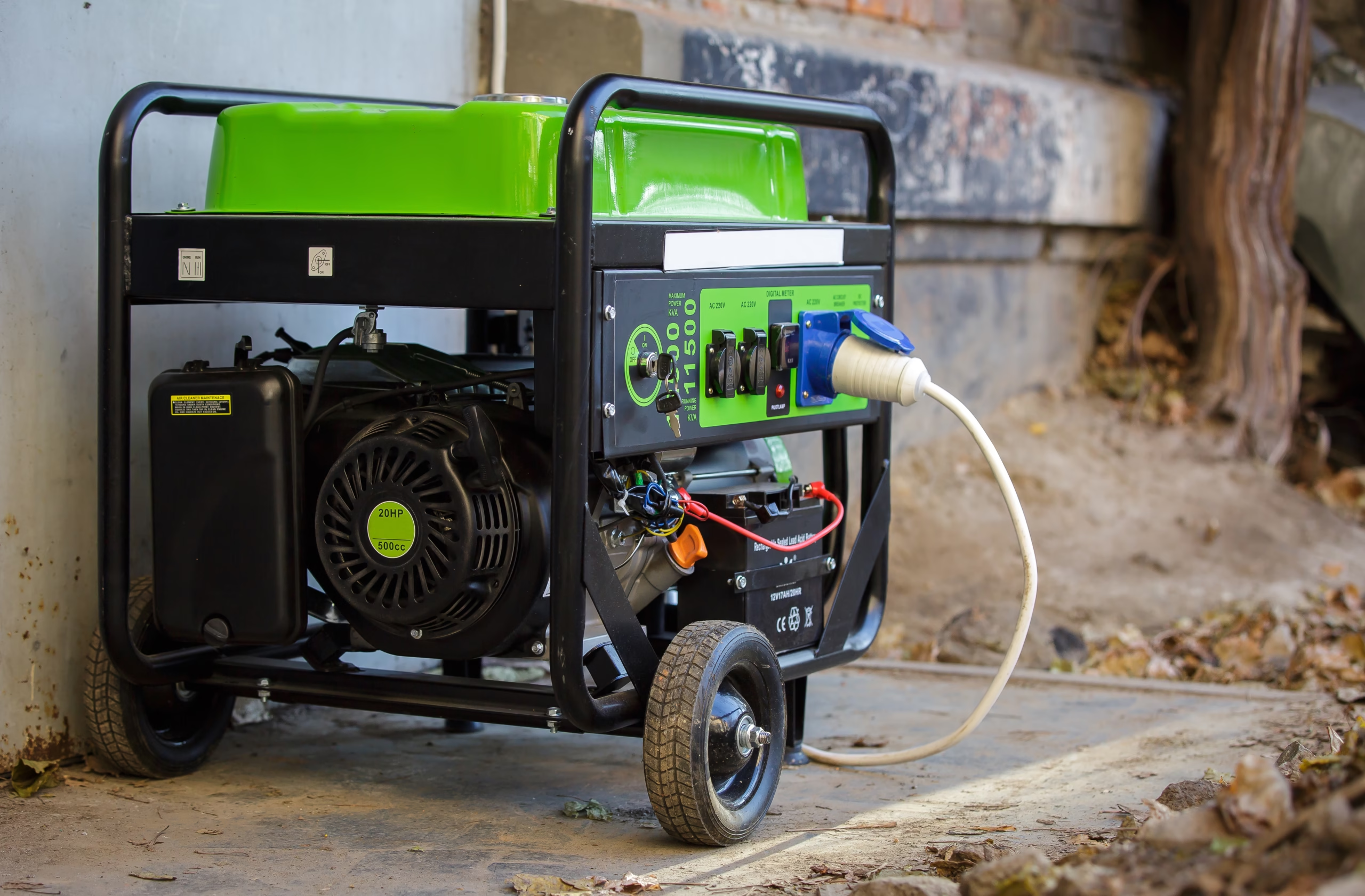
What Size Generator Do I Need? Whole-House kW Calculator
Square footage won’t tell you what size generator you need. Your loads will. Add up running watts, add the single biggest motor surge, then derate for fuel, heat and altitude. The calculator below does the math and shows you each step.
The Brofessionals is reader-supported. When you buy through links on this page we may earn a small commission at no extra cost to you. As an Amazon Associate we earn from qualifying purchases. See our full disclosure.
Most “what size generator do I need” answers start with your home’s square footage. Generac says it plainly: sizing is about electrical load, not square footage. Two 2,000 sq ft houses can need a 14 kW and a 26 kW unit. The difference usually comes down to one or two things: central air and electric heat, cooking or hot water. This guide is part of our backup power and generators hub. If you haven’t decided between a generator, a power station or a UPS yet, start with power station vs generator vs UPS.
The short answer
| What you want to run | Typical size range | What pushes you up a size |
|---|---|---|
| Essentials only (fridge, freezer, sump or well pump, furnace fan, lights, Wi-Fi) | Portable 5–8 kW, or standby 10–14 kW with load management | A 1 HP well pump; running a microwave or space heater at the same time |
| Essentials + one central AC (2–3 ton) | Standby 14–22 kW | An AC with no soft starter (big starting surge), natural gas fuel, hot climate |
| Whole house with gas heat, water heater and range | Standby 18–24 kW | Two AC systems, a heat pump |
| Whole house, all-electric (water heater, range, dryer, heat) | 24 kW and up, or a smaller unit with load management | Electric resistance heat or heat-strip backup |
These ranges come from running the method below on the wattage figures in the table further down. Generac’s own guide lands in a similar place: 10–14 kW with load management for essentials in a ~1,550 sq ft home, and 18–22 kW as the “sweet spot” for ~2,000 sq ft homes. Treat the table as a starting point, then run your own numbers.
How generator sizing actually works (4 steps)
- List what must run at the same time. Don’t list everything you own. List what would be on at 6 pm on a July evening with the power out.
- Add the running watts of everything on that list. That’s the steady load.
- Add the single largest starting surge. Motors (AC compressors, well and sump pumps, fridges, furnace blowers) pull two to three times their running watts for a second or two when they start. Generac describes it the same way. You only add the biggest one, because motors rarely start at the exact same instant. On a standby unit, the transfer switch or load manager can stagger them.
- Derate for your site. Generator ratings assume ideal conditions. Generac’s Guardian spec sheet says output drops about 3.5% per 1,000 ft of elevation and 1% per 10°F above 60°F. Air-cooled standby units also make less power on natural gas than on propane. The 24 kW Guardian is rated 24,000 W on LP but 21,000 W on NG.
The formula the calculator uses:
Peak watts = total running watts + (largest starting watts − that item’s running watts)
Nameplate kW to shop for = peak watts ÷ fuel factor ÷ site factor, rounded up to the next size sold.
Generator size calculator
Tick everything that must run at the same time. Wattages are the top of the ranges in Champion Power Equipment’s published chart. If you know your own appliance’s numbers from its nameplate, use the custom rows.
Custom load 2: running W, starting W
An estimate for planning and comparing quotes. It isn’t a code load calculation. See “What the electrical code says” below.
Starting vs running watts, by appliance
The calculator uses the top of each range below so it errs toward too big rather than too small. The ranges are wide because a new ENERGY STAR fridge and a 20-year-old one are very different machines. For comparison, Honda lists an ENERGY STAR refrigerator/freezer at 132–192 W running and 1,200 W starting.
| Appliance | Running watts | Starting watts |
|---|---|---|
| Refrigerator | 150–400 | 800–1,200 |
| Freezer | 100–500 | 500–1,000 |
| Sump pump, 1/2 HP | 800–1,050 | 1,300–2,150 |
| Well pump, 1 HP | 1,000–2,000 | 2,000–4,000 |
| Furnace fan, 1/2 HP | 300–800 | 800–1,600 |
| Central AC, 2 ton | 2,000–2,500 | 3,500–4,500 |
| Central AC, 3 ton | 3,000–3,500 | 5,000–6,000 |
| Central AC, 4 ton | 4,000–5,000 | 6,500–8,000 |
| Window AC, 10,000 BTU | 900–1,200 | 1,800–2,400 |
| Electric water heater | 3,000–4,500 | same as running |
| Electric dryer | 4,000–6,000 | same as running |
| Microwave | 600–1,200 | same as running |
Source: Champion Power Equipment generator wattage chart (page updated April 2026). Honda figures from its generator wattage estimation guide.
The central AC problem: sources disagree by 3x
Here’s where generic charts can mislead you. Champion lists a 3-ton central AC at 5,000–6,000 starting watts. Generac’s sizing guide says the same 3-ton unit runs on about 3.5–5 kW but “can demand up to 15kW to 18kW in starting power.” Both can be true. It depends on the compressor, its age and whether it has a soft starter.
The way to find out for your own unit is the LRA (locked-rotor amps) figure on the outdoor condenser’s data plate. At 240 V, starting power is roughly LRA × 240. An 80 LRA compressor is roughly 19,000 VA for a split second. Enter your LRA in the calculator and see how much it moves the answer. If the number is ugly, ask your installer about a soft-start kit. It can let you drop a size or more.
Worked example: a 2,000 sq ft house on natural gas
Fridge, freezer, 1/2 HP sump pump, furnace blower, 3-ton central AC, lights, TV, chargers and a microwave. Natural gas fuel, 1,000 ft elevation, 95°F summer highs:
| Step | Chart AC surge | AC surge per Generac’s upper figure |
|---|---|---|
| Running load | 8,300 W | 8,300 W |
| Largest extra surge (the AC) | +2,500 W | +11,500 W |
| Peak demand | 10,800 W | 19,800 W |
| ÷ NG factor 0.875 ÷ site factor 0.93 | 13.3 kW | 24.3 kW |
| Next size up | 14 kW | 26 kW |
Same house, same appliances, and the answer is either 14 kW or 26 kW. The only difference is how hard the AC compressor kicks at startup. That’s why a real installer looks at the condenser nameplate, and why the calculator lets you enter LRA. Installed cost roughly tracks kW, so this one number can be worth thousands. See our home backup generator cost breakdown and itemized Generac install costs.
Portable generator? Same math, smaller list
For a portable unit, the rated (running) watts must cover your running total and the surge (starting) watts must cover your peak. Run the calculator with only the circuits your inlet and interlock or transfer switch will feed. For a fridge and freezer alone, see our dedicated guide on what size generator runs a fridge and freezer. Honda’s advice for portables is the key trick: start big motors one at a time, and don’t add up every starting watt.
What the electrical code says (and when you need an electrician)
- Automatic transfer switch = the generator must carry everything it switches. Under NEC Article 702.4 (2023 edition), an optional standby system with automatic transfer must be able to supply the full load it transfers. The alternative is an energy management system (load shedding) that limits what gets connected. North Carolina’s Office of State Fire Marshal issued a formal interpretation in December 2024: manual load management is not allowed behind an automatic transfer switch. An ATS whole-house setup can’t rely on you “just not running the dryer.”
- Manual transfer (interlock kit or manual transfer switch) lets the user decide what runs, so the generator only has to cover what you choose to switch on. See interlock kit vs transfer switch.
- The official load calculation is done under NEC Article 220 or another method your local inspector (the “authority having jurisdiction”) accepts. That is the electrician’s job, not a web calculator’s.
- Hire a licensed electrician and pull a permit for any standby generator, transfer switch or interlock installation. Local rules vary, so check with your building department. Never backfeed a house through a dryer outlet or a “suicide cord.” It can energize utility lines and kill a line worker.
Generac’s own support team says it won’t size generators remotely, because it can’t inspect the site or know local codes. It sends buyers to a free in-home assessment instead. Use this calculator to walk into that assessment knowing roughly what the answer should be. That makes an oversized quote easy to spot.
Five sizing mistakes we see most
- Sizing by square footage. Your loads matter, not your floor area.
- Adding every starting watt together. That oversizes badly. Add running watts, then only the biggest surge.
- Forgetting natural gas derating. A “24 kW” air-cooled unit is 21 kW on NG, according to Generac’s spec sheet.
- Ignoring heat and altitude. At 5,000 ft and 100°F, the spec-sheet derates take away roughly 21–22% of output.
- Assuming an ATS can run “everything, just not all at once.” Without an energy management system, code requires the generator to carry the full transferred load.
Two cheap meters make this calculator far more accurate than any chart. A plug-in watt meter reads real running watts on anything with a 120 V plug. A clamp meter with an inrush function lets an electrician measure a motor’s actual starting current.
FAQ
Sources
- Generac, What Size Generator Do I Need? Sizing Guide (accessed Sep 29, 2026)
- Generac Support, How Do I Correctly Size a Generator for My Home? and What kW sizes does Generac offer (air-cooled)
- Generac, 20/22/24 kW Guardian spec sheet, A0000937814 Rev. F (09/28/2022): LP vs NG ratings and derating
- North Carolina Office of State Fire Marshal, interpretation of 2023 NEC Articles 702/705/706/710 (Dec 1, 2024)
- EC&M, Code Q&A: Sizing an Optional Standby Generator (context on 702.4 and Article 220)
- Champion Power Equipment, Generator Wattage Chart (updated Apr 2026)
- Honda Power Equipment, Generator wattage estimation guide and What size generator do I need?
How we researched this
This is a research-based guide, not a hands-on test. We built the method and the calculator from manufacturer documents (Generac’s sizing guide, support articles and Guardian spec sheet; Champion’s and Honda’s wattage charts) and a state fire marshal’s written interpretation of the 2023 National Electrical Code. We opened every source listed above on September 29, 2026. Appliance wattages are published typical ranges, not measurements of any specific appliance, and your nameplate numbers win.