What Size Generator Runs a Fridge AND Freezer?
The wattage printed on your fridge isn’t the number that trips a generator. The compressor’s startup surge is. Here’s how to size a generator or power station for a refrigerator and a separate freezer, with real numbers, a worked example and a quick calculator.
The Brofessionals is reader-supported. When you buy through links on this page we may earn a small commission at no extra cost to you. As an Amazon Associate we earn from qualifying purchases. See our full disclosure.
The short answer
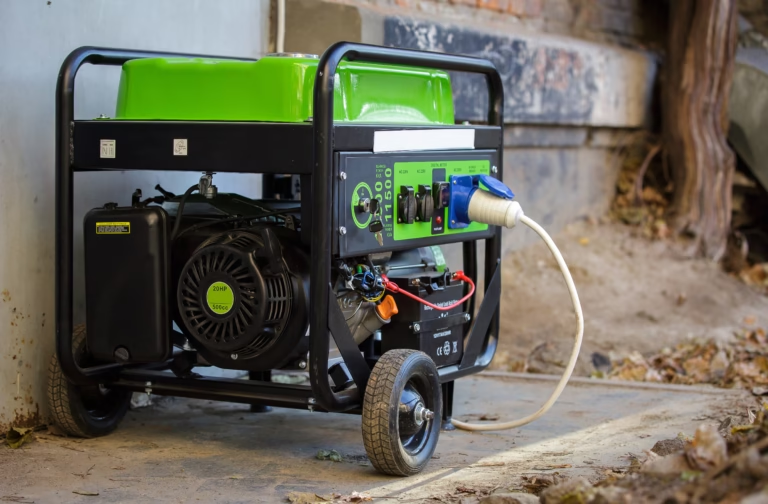
For a typical full-size fridge plus a chest or upright freezer, plan on a generator rated about 1,800 running watts and 2,200 starting watts if you’ll stagger compressor starts, or a 3,000W-class unit if you want both compressors (plus lights and a router) to start together without thinking about it. That lines up with a 2,200W inverter such as Honda’s EU2200i (1,800W rated, 2,200W max) on the low end.
Below is where those numbers come from, so you can check them against your appliances. We haven’t bench-tested these generator classes side by side; the figures are manufacturer charts, ENERGY STAR data and basic electrical math.
Running watts vs. startup surge
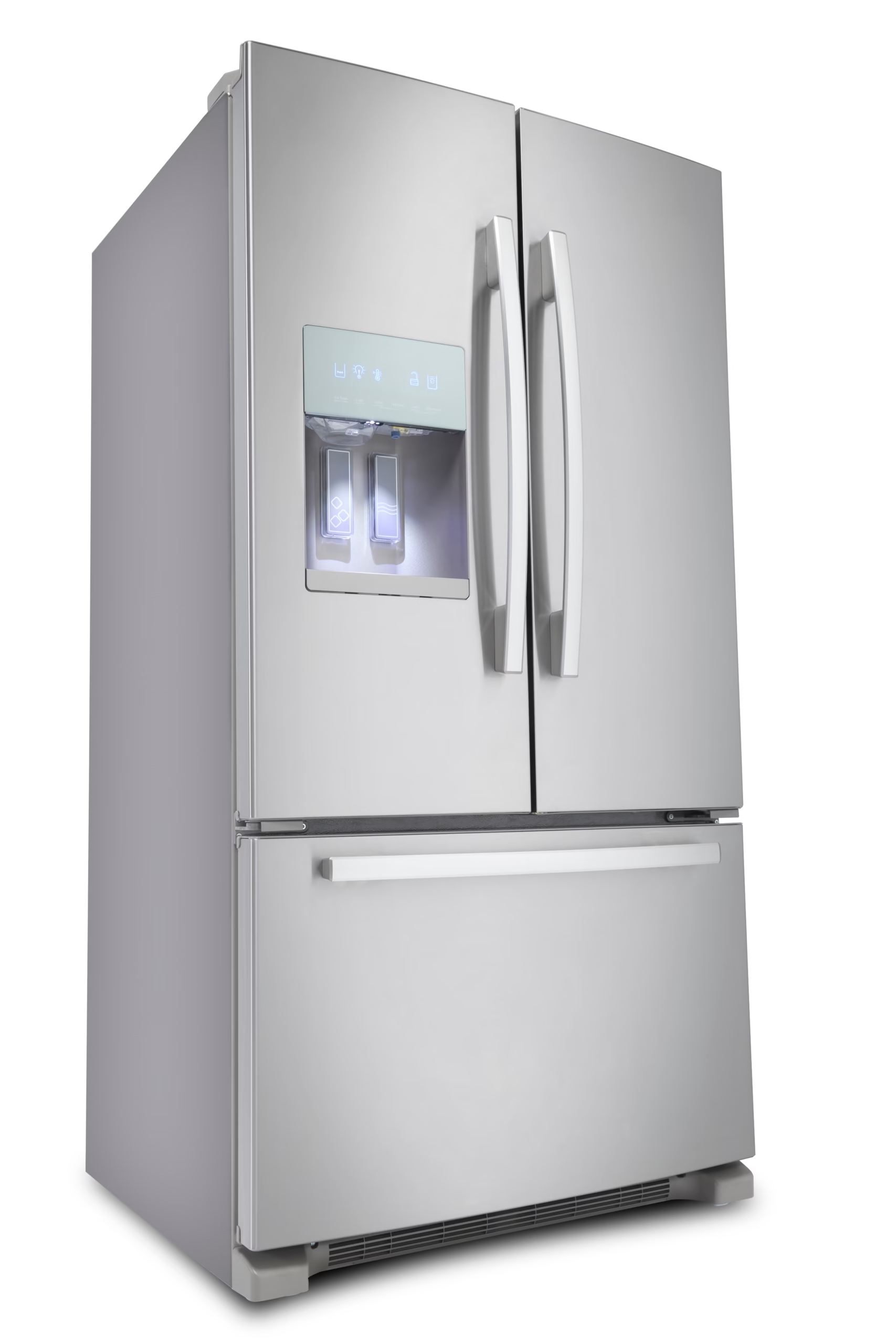
A refrigerator compressor doesn’t run all the time. It cycles on, pulls its running wattage for a while, then shuts off. Every time it starts, the motor briefly pulls far more current than it does once it’s spinning. Virginia Tech Extension notes that motors draw roughly three times their running current at startup, and generator makers’ charts show even bigger spikes: Honda’s sizing example lists a refrigerator at 200 running watts and 1,600 starting watts.
The spike lasts a moment, but if the generator can’t supply it, the compressor stalls or the breaker trips. So size for two numbers: the running total of everything on, and the starting peak when a compressor kicks on.
Wattage and energy by fridge and freezer type
Running and starting watts below come from Champion’s generator wattage chart, which gives one range for full-size refrigerators, one for freezers and one for mini fridges; it doesn’t split by door style. The yearly energy numbers come from the ENERGY STAR certified-product database (average and range across certified models), which is where the style differences show up. Larger side-by-side and bottom-freezer/French door models with ice makers use noticeably more energy, so expect them toward the upper end of the watt ranges.
| Type | Running watts (compressor on) | Starting watts | ENERGY STAR avg kWh/yr (range) | Avg kWh/day |
|---|---|---|---|---|
| Top-freezer refrigerator | 150–400W | 800–1,200W | 365 (121–506) | about 1.0 |
| Side-by-side refrigerator | 150–400W | 800–1,200W | 636 (420–805) | about 1.7 |
| French door / bottom-freezer | 150–400W | 800–1,200W | 557 (200–799) | about 1.5 |
| Chest freezer | 100–500W | 500–1,000W | 263 (201–346) | about 0.7 |
| Upright freezer | 100–500W | 500–1,000W | 450 (247–649) | about 1.2 |
| Mini / compact fridge | 50–100W | 400–600W | 257 (106–470) | about 0.7 |
ENERGY STAR lumps French door models into its “Bottom Freezer” category, and its kWh figures are lab-test ratings of certified (efficient) models. An older fridge, a hot garage, or a family opening the door all day will use more.
How to read your own fridge’s rating label
The rating label (nameplate) is usually inside the fresh-food compartment on a side wall, behind the crisper drawer, or on the back near the compressor. You’ll typically find volts and amps, sometimes watts, and occasionally compressor details.
Step 1: Convert amps to watts
If the label lists amps, multiply by volts: watts = amps × volts. A label reading 115V and 6.5A works out to about 750W. Treat that as a ceiling, not what the fridge pulls minute to minute; the label rating is a maximum that often includes the defrost heater and ice maker, not just the compressor running.
Step 2: Look for LRA if it’s there
Some compressors have their own sticker with RLA (running load amps) and LRA (locked rotor amps). LRA is the inrush current at the instant of startup, when the motor hasn’t begun turning. Industry references put LRA at roughly 5–8 times RLA for reciprocating compressors.
LRA × volts is a worst-case figure. It exists for only a fraction of a second before the motor spins up, so it overstates what a generator actually has to carry. Use it as a pessimistic upper bound.
Step 3: Estimate starting watts
If you have no LRA, a common planning shortcut is 2–3× running watts for starting watts, which matches Champion’s refrigerator range (150–400 running, 800–1,200 starting) and Virginia Tech’s “about three times” for motors. Just know that some charts go well beyond that; Honda’s example fridge is 8×. If your generator is marginal, assume the higher number.
Worked examples
- Label says 115V, 6.5A. Maximum is about 750W. The compressor alone typically runs well under that, so plan with the chart: about 400W running and 1,200W starting for a full-size fridge.
- Compressor sticker says RLA 1.5A, LRA 9A at 115V. Running is about 170W (1.5 × 115). Worst-case inrush is about 1,035W (9 × 115). Budget roughly 1,000W starting.
Measure it if you can
A plug-in watt meter (such as a Kill A Watt) tells you real running watts and, left in place for a day, real kWh per day. That kWh number is the one to use for battery runtime. Plug-in meters aren’t built to capture a split-second startup spike, so keep using the label or chart for starting watts.
Sizing for a fridge AND a freezer together
Here’s the method Honda and Champion both describe: add up the running watts of everything that will be on, then add the extra starting watts of the biggest motor that might start. If two compressors could start at the same moment, add both extras.
Worked example
| Load | Running watts | Extra watts at startup |
|---|---|---|
| Full-size refrigerator (upper end) | 400 | 800 (1,200 start − 400 run) |
| Chest or upright freezer (upper end) | 500 | 500 (1,000 start − 500 run) |
| 5 LED bulbs at 10W | 50 | 0 |
| Internet router/modem | 20 | 0 |
| Two phone chargers at 20W | 40 | 0 |
| Total | 1,010 |
- Staggered starts (only one compressor starts at a time): 1,010 + 800 = 1,810W peak.
- Both compressors start together: 1,010 + 800 + 500 = 2,310W peak.
- Add a 20% margin (generators don’t like living at their limit, and altitude and heat reduce output): about 1,210W running, and 2,170W starting staggered or 2,770W starting simultaneous.
A 2,200W inverter like the EU2200i (1,800W rated, 2,200W max) covers that running load and, just barely, the staggered peak. It doesn’t cover both compressors starting at once with margin. A 3,000W-class generator does.
Staggering starts in practice
Compressors cycle on their own schedule, so you can’t fully control this. When the generator first comes on, plug in the fridge, wait until its compressor is running, then plug in the freezer. Skip the microwave, coffee maker and space heater if you’re sized this tight. Honda’s own example shows a 3,000W generator handling appliances that total far more when the big loads start at different times.
Inverter vs. conventional generators
- Inverter generators (like the EU2200i) are quieter, throttle down at light loads, and produce clean power. Their surge headroom is modest, so starting watts are usually the constraint.
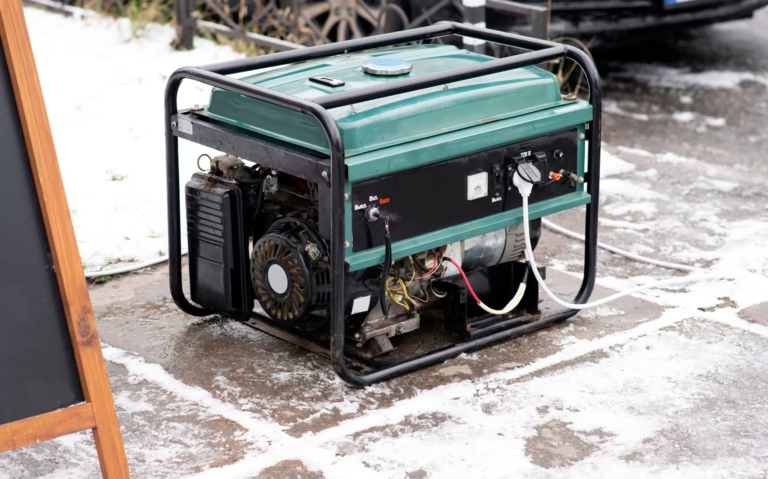
- Conventional open-frame generators give you more running and starting watts per dollar and handle compressor surges well, but they’re louder and burn more fuel at light loads, which is exactly what a fridge and freezer are most of the day.
Interactive calculator
Enter the running and starting watts of your bigger compressor appliance (use the table or your label), how many compressor appliances you’ll run, and the total of your small extras (lights, router, chargers). It adds a 20% margin.
Recommended running watts: –
Recommended starting watts, staggered starts: –
Recommended starting watts, all compressors at once: –
For a power station, use the same numbers: continuous output at least the running figure, surge rating at least the starting figure.
The power station option
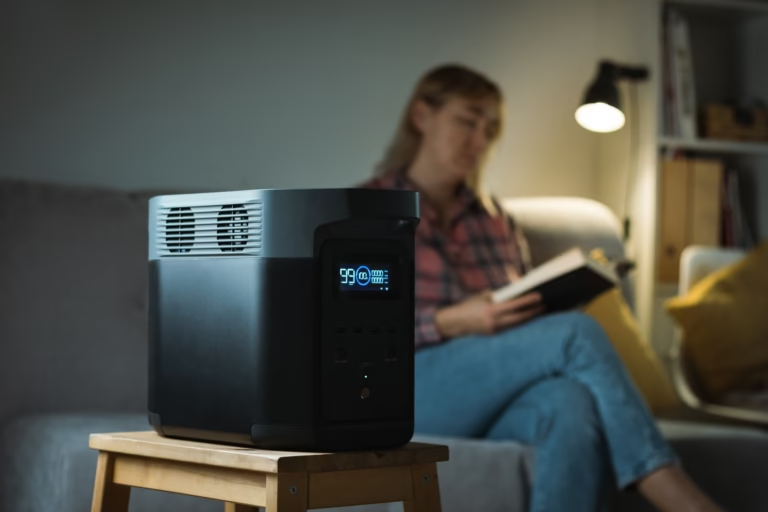
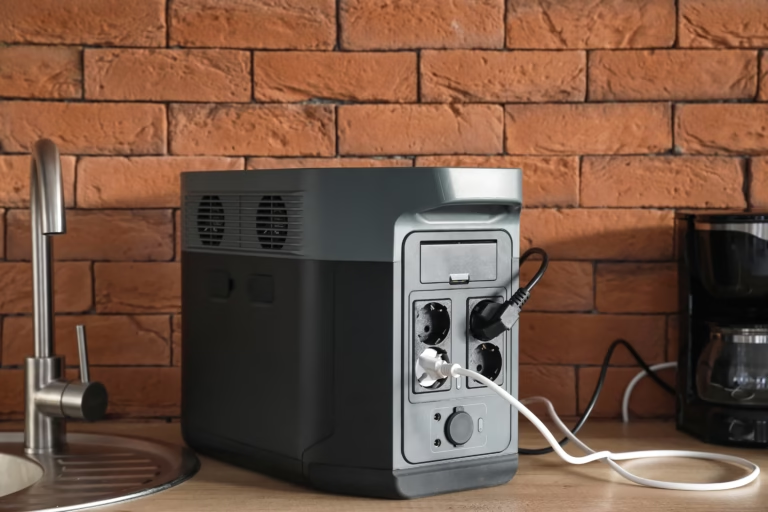
A portable power station has no fumes and can sit in the kitchen, but it runs out of energy. You need to check two things: can it start the compressor, and how many watt-hours does it hold.
- Surge rating: must beat your starting watts. The EcoFlow DELTA 3 Plus, for example, lists 1,800W continuous and 3,600W surge, which clears the worked example above even with simultaneous starts.
- Runtime: usable watt-hours ÷ daily energy use. Power stations lose some energy converting battery DC to household AC. Jackery’s own runtime formula uses a 0.85 factor: hours = capacity (Wh) × 0.85 ÷ load (W).
Runtime example (duty cycle)
A fridge doesn’t draw its running watts 24 hours a day because the compressor cycles. Virginia Tech Extension’s rule of thumb is to count a refrigerator as running about one-third of the time. So a fridge that pulls 150W while running uses roughly 150W × 8 hours = 1.2 kWh per day, close to the ENERGY STAR averages above.
Now the pair: an average French door fridge (about 1.5 kWh/day) plus an average chest freezer (about 0.7 kWh/day) is about 2.2 kWh per day, or roughly 92W averaged over the day.
- DELTA 3 Plus: 1,024Wh × 0.85 ≈ 870Wh usable.
- 870Wh ÷ 92W ≈ 9.5 hours for both appliances, from a full charge.
- Fridge alone (about 63W average): 870 ÷ 63 ≈ 14 hours.
That covers an evening outage, not a multi-day one, unless you add solar or an expansion battery. For comparisons of 1kWh-class units, see our Jackery Explorer 1000 v2 vs EcoFlow DELTA 3 Plus breakdown, and for the bigger picture, power station vs generator vs UPS.
Generator fuel, same load
Honda rates the EU2200i at 8.1 hours on its 0.95-gallon tank at quarter load (about 450W). The fridge-plus-freezer average is well below that, so plan on at least 8 hours per tank, or roughly 3 gallons a day as a conservative figure. Store that fuel safely and stabilize it; stale gas is the top reason a generator won’t start when you need it (see our carb fix guide).
How long you can go without power at all
FoodSafety.gov says a closed refrigerator keeps food safe for up to 4 hours, and a full freezer holds a safe temperature for about 48 hours (24 if half full). That means you don’t need to run the freezer continuously. Running the generator or power station a few hours at a time, and keeping doors shut, stretches fuel and battery a long way.
Pros
- A 2,200W inverter generator is quiet, fuel-efficient and big enough for most fridge + freezer setups if you stagger starts
- A 3,000W-class unit removes the need to babysit compressor starts
- A 1kWh power station with a high surge rating runs both indoors, fume-free, for most of a day
Cons
- Sizing on running watts alone is the most common mistake; the startup surge is what stalls the compressor
- Light-duty extension cords can drop voltage and make a marginal generator worse
- Older fridges and freezers can draw noticeably more at startup and over a day than the ENERGY STAR averages
Check 2000 Watt Inverter Generator on Amazon → Check Portable Power Station Home Backup on Amazon →
Safety: the part that actually matters
- Never backfeed. Don’t plug a generator into a wall outlet with a double-male cord. OSHA warns this can energize wiring for great distances and electrocute utility workers. It can also start a fire in your house.
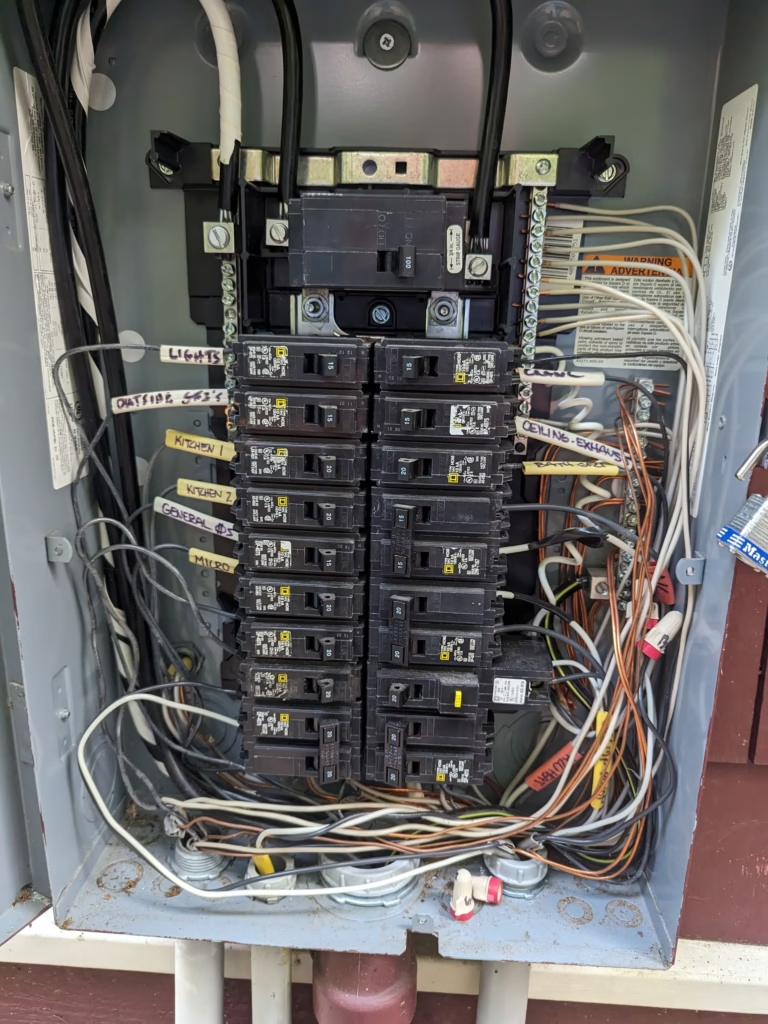
- Connecting to your panel requires a licensed electrician. OSHA says a generator should only be tied to a building’s wiring through a properly installed transfer switch. An interlock kit plus an inlet box is the other code-recognized route. Either one needs a licensed electrician and, in most places, a permit and inspection. See interlock kit vs transfer switch for the tradeoffs and home backup generator cost in 2026 for what installs run.
- Short of that, use cords. Run a heavy-duty outdoor extension cord from the generator to the fridge and freezer. Match the cord’s gauge to the load and length.
- Weather. Rain and snow don’t change the 20-foot rule. If you need cover, read can you run a generator in the rain before improvising a shelter.
Sizing for the whole house rather than one appliance? Use our whole-house generator size calculator.
FAQ
Read next: How Much Does a Home Backup Generator Cost in 2026 · Portable Power Station vs Generator vs UPS · browse all backup power guides · Jackery Explorer 1000 v2 vs EcoFlow DELTA 3 Plus: Which 1kWh Station Wins? · EcoFlow DELTA 3 Classic vs Anker SOLIX C2000 Gen 2 · Can You Run a Generator in the Rain?
Sources
- Champion generator wattage chart: refrigerator 150–400W running / 800–1,200W starting; freezer 100–500W / 500–1,000W; mini fridge 50–100W / 400–600W; LED bulb 8–15W; router 10–20W; chargers 20–100W
- Honda: how much generator power do you need: refrigerator 200W running, 1,600W starting; staggering starts
- Honda EU2200i specs: 1,800W rated, 2,200W max; 8.1 hours at 1/4 load; 0.95-gallon tank
- ENERGY STAR Certified Residential Refrigerators (dataset): average and range of annual kWh by type
- ENERGY STAR Certified Residential Freezers (dataset): average and range of annual kWh for chest and upright freezers
- Virginia Tech Extension: Estimating Appliance and Home Electronic Energy Use: amps × volts, daily kWh formula, refrigerator on about one-third of the time, motors about 3× current at startup
- RLA, FLA and LRA explained: definitions; LRA about 5–8× RLA for reciprocating compressors
- Jackery: what is a watt-hour: runtime formula with 0.85 efficiency factor
- EcoFlow DELTA 3 Plus: 1,024Wh, 1,800W continuous, 3,600W surge
- FoodSafety.gov: food safety during a power outage: fridge 4 hours; full freezer about 48 hours, half full 24
- CPSC carbon monoxide safety tips (2025): 20-foot rule, no porches or carports, CO alarms
- OSHA: Using Portable Generators Safely (fact sheet): transfer switch installed by a qualified electrician; backfeed hazard to utility workers
Checked September 2026. Prices and specs change; confirm on the linked pages before you buy.